

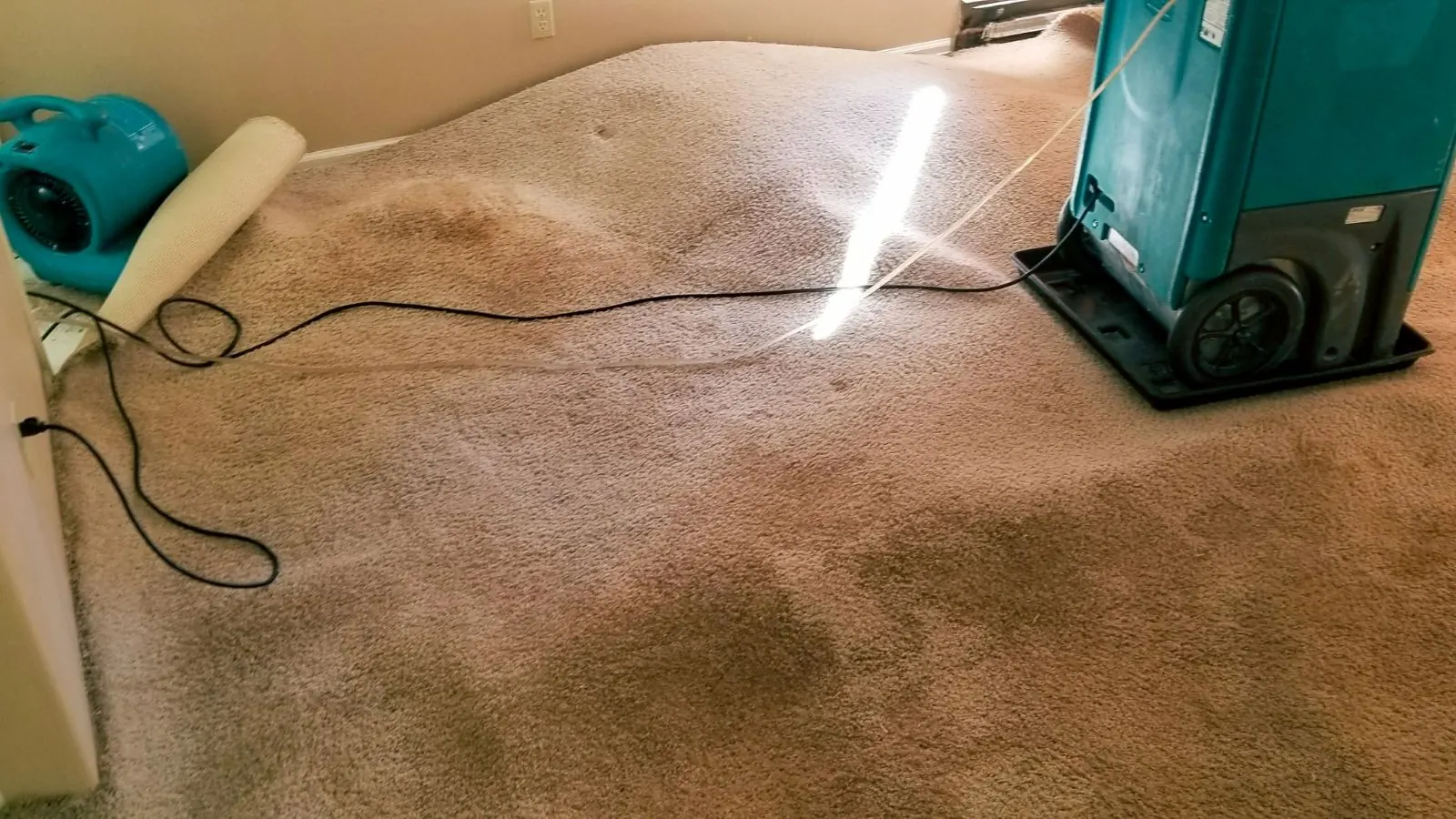
Wet carpet is time-sensitive because the pad underneath acts like a sponge. Lift furniture off the carpet, put foil or blocks under legs, and call the 24/7 line so extraction can start. Do not walk on a saturated carpet more than needed, and keep pets and children off it if the water may be contaminated.
Carpet water damage restoration is the extraction, drying, cleaning or replacement of carpet and pad after water exposure. Whether carpet can be saved depends on the water category and how long it stayed wet, not just how bad it looks.
Carpet jobs often start with a water extraction and finish with structural drying. If the source was a drain or toilet, see sewage cleanup.
Wet carpet: what to do first
The goal is to stop wicking and protect belongings.
- Stop the source and lift furniture, or place foil or plastic under the legs.
- Remove small rugs and loose items from the wet area.
- Open windows only if the weather helps drying, otherwise leave the HVAC alone and call.
- Photograph the carpet and the source before extraction.
Save or replace: how the water category decides
The ANSI/IICRC S500 water categories guide this decision.
| Water category | Carpet | Pad |
|---|---|---|
| Category 1, clean | Usually saved if dried quickly | Often replaced to dry the subfloor, sometimes saved. |
| Category 2, gray | Often cleaned and dried | Usually replaced. |
| Category 3, black | Usually discarded | Discarded. |
Carpet squishing underfoot?
Call the 24/7 line and start extraction.
How carpet restoration works
- Weighted extraction tools press water out of carpet and pad.
- The crew lifts a corner and checks the pad and the subfloor with moisture meters.
- Pad that cannot be saved is removed so the carpet and subfloor can dry.
- Air movers and dehumidifiers run until readings meet the dry standard, and the carpet is cleaned and re-stretched or replaced.
The pad is usually the problem
Carpet fibers dry readily, but foam or rebond pad holds moisture and can stay wet under dry-looking carpet. That trapped moisture feeds odors and can reach the subfloor, so pad replacement is common even when the carpet is saved.
Berber and loop carpets can show wicking stains and delamination, and cut pile may re-stretch without trouble. A crew checks both the carpet and the pad before recommending a plan.
What affects carpet restoration costs
The decision to save or replace sets the range.
Water category
Cleaner water saves more.
Time wet
A day or two changes the odds.
Area
Wall-to-wall rooms add pad removal and re-stretching.
Subfloor drying
Wet subfloor needs more drying days.
Sudden water events are often covered, and ask your insurer about replacement rather than cleaning.
Carpet types and how each reacts
Synthetic fibers such as nylon and polyester release water readily, while wool and natural blends hold it longer and can shrink or bleed dye. Cut pile usually re-stretches well, and loop styles such as berber can show wicking stains and backing separation. Glued-down carpet on a slab behaves differently from carpet stretched over pad.
A crew checks the backing, the seams and the tack strips, because delamination or rusted strips mean the carpet cannot be reinstalled even if it dries.
After drying: cleaning, odor and reinstalling
- Hot water extraction or an approved cleaning method removes residue and lifts odor.
- A deodorizing treatment may follow if the carpet sat damp for a day or more.
- The carpet is re-stretched and secured to new or dried tack strips.
- The subfloor is checked once more with a moisture meter before the final installation.
- If the carpet cannot be saved, the crew documents it for your insurer and removes it for disposal.
Wet carpet questions
Can you start on wet carpet the same day in Waunakee?
Same-day response is offered when crews are available. Call, describe the water and how long the carpet has been wet, and dispatch arranges a visit.
Can wet carpet be saved?
Often when the water was clean and extraction starts quickly. Sewage water usually means the carpet is discarded.
Why is the pad replaced?
Pad holds water and stays wet under dry-looking carpet. Replacing it helps the subfloor dry and avoids odors.
How long until carpet is dry?
Drying often takes several days, and readings decide when it is done.