

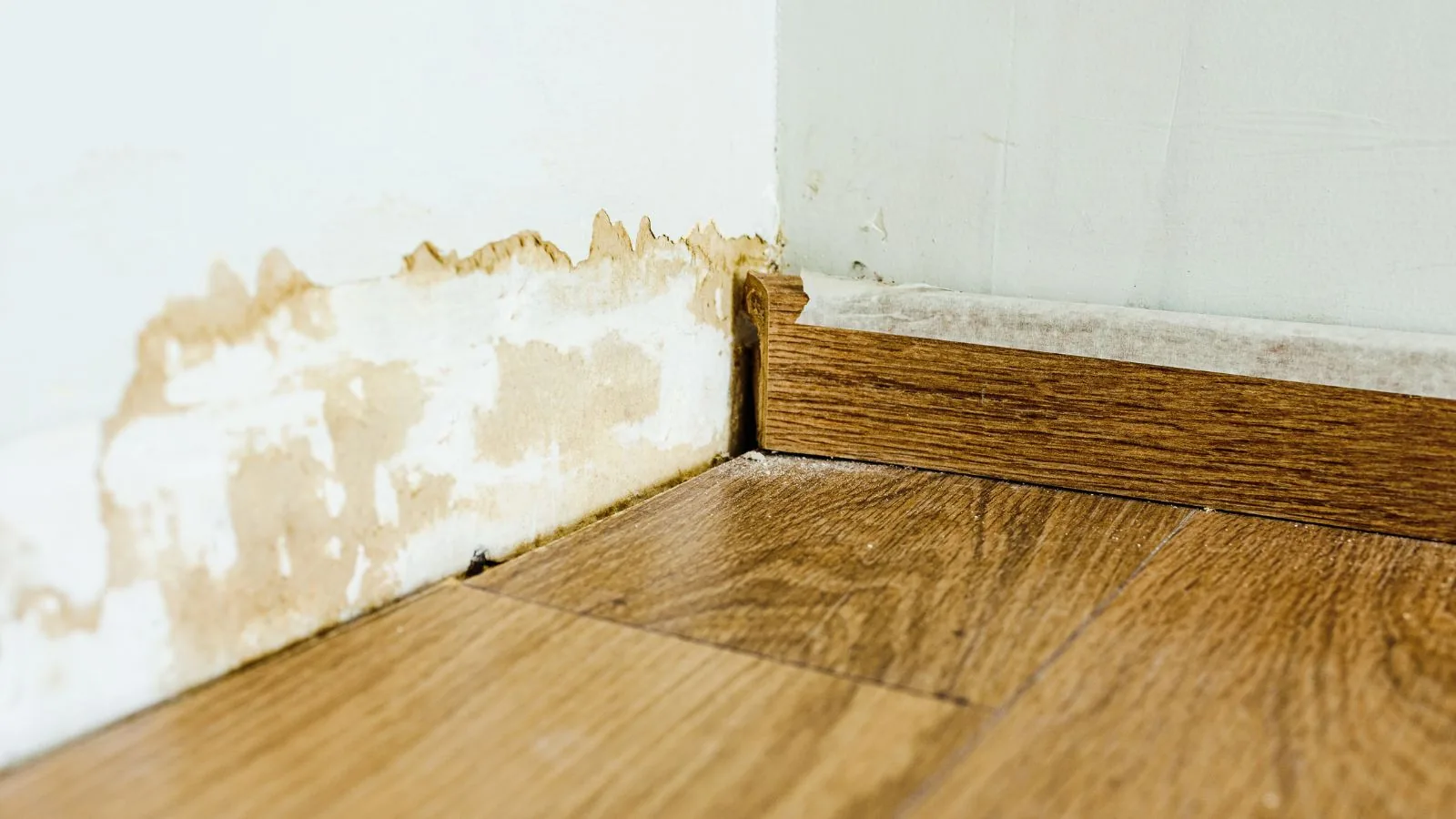
A wall that stains, bubbles or goes soft after a leak is telling you water is inside it. Drywall wicks moisture upward and holds it against studs and insulation long after the surface looks dry. Do not paint over a stain, and call dispatch for a moisture check before you close anything up.
Wall and drywall water damage repair is the drying, removal and replacement of wet wall materials. The cavity behind the drywall holds insulation, framing and sometimes wiring, so opening it is often the fastest route to a dry wall.
Walls get wet from supply lines, drains, roofs and floors. See burst pipes, ceilings and structural drying for related work.
Signs a wall is wet inside
Surface clues usually show up before structural problems.
| Sign | What it suggests | Next step |
|---|---|---|
| Bubbling or peeling paint | Moisture behind the paint | Moisture reading. |
| Brown or yellow stain | Water has passed through repeatedly | Find the source. |
| Soft or crumbling drywall | Saturated gypsum | Likely removal. |
| Musty smell, no visible stain | Hidden wet cavity | Thermal imaging and meter check. |
| Warped baseboard | Moisture at the wall base | Check the floor and cavity. |
When drywall can be dried and when it must go
Drywall exposed briefly to clean water can often be dried in place, particularly if the wall cavity is opened or ventilated. Saturated gypsum loses strength, sags and can host mold, and it is cut out. Contaminated water means removal regardless of how the board looks.
The usual cut is a clean line a short distance above the water line, so the repair patch is straight and the studs are exposed to dry. Insulation behind wet drywall is removed, since it holds water against the framing.
Wall bubbling or stained?
Call dispatch for a moisture check.
How a wall repair proceeds
- The source is stopped and repaired by the right trade.
- The crew maps moisture and cuts out wet drywall and insulation.
- Air movers and dehumidifiers dry studs and plates with logged readings.
- New drywall is hung, taped, finished and primed once the framing is dry, and painting is a separate finishing step.
What affects wall repair costs
Repair scope follows how much comes out.
Wall area removed
Larger cuts mean more finishing.
Insulation and cavities
Wet insulation is replaced.
Finishes
Texture and paint matching add work.
Drying time
Studs and plates dry slowly.
Sudden leaks are often covered and slow leaks usually are not. Ask your insurer, and keep photos of the stain.
Mold, paint and finishing
Wet drywall that stays wet can grow mold within days, and painted surfaces can hide it. If growth is present, testing and remediation follow ANSI/IICRC S520, and any health question belongs to a physician. This site does not diagnose or promise outcomes.
Finishing is a craft step. New drywall is taped, mudded and sanded, then primed, and texture is matched where the wall had one. Paint should wait until the compound is fully dry, and you may need to repaint a whole wall to hide the patch.
The repair sequence in order
- Stop the source and confirm it is repaired.
- Map moisture and mark the cut lines.
- Remove wet drywall and insulation, bagging as you go.
- Dry the cavity until readings hold at the dry standard.
- Install new insulation and drywall, tape, mud and sand.
- Prime and paint, matching the existing finish.
Wiring, outlets and safety in a wet wall
Walls carry wiring, outlets and sometimes gas or plumbing lines. If water has reached an outlet or a switch box, stay away from it and have the circuit shut off at the panel by someone who can reach it on dry floor. Call your electric utility or 911 if there is any doubt.
A licensed electrician checks the wiring after the wall is opened and dried. We cut around it carefully, and we do not reconnect or replace electrical components ourselves.
Wall and drywall questions
Can you check a stained wall the same day in Waunakee?
Same-day response is offered when crews are available. Call and describe the stain and the likely source.
Can I paint over a water stain?
Not safely until the source is fixed and the wall is dry. Stains bleed through paint and wet drywall can grow mold.
Does wet drywall always have to be replaced?
No. Briefly wet drywall from clean water can often be dried. Saturated or contaminated board is removed.
Does insurance cover drywall water damage?
Sudden leaks are often covered, and slow leaks usually are not. Check your policy.